
Padel's Record Growth in 2026: What It Means for Club Owners
The Global Padel Report 2026 puts the sport at 58,300 courts worldwide. Here is what the latest market data and Premier Padel results mean for club operators in the UK and beyond.
Written by Serve Team
The numbers that should be on every club owner's radar
The Playtomic and PwC Strategy& Global Padel Report 2026 puts the global padel footprint at 58,300 courts, nearly 20,000 clubs, and 19.4 million active players on their tracked network — with projections pointing to 91,000 courts globally by 2028. The FIP World Padel Report 2025 tells a broader story: 77,300 courts, 24,600 clubs, and 35 million players across 150 countries, with court counts growing at 15.2% and club numbers at 16.1% year on year. Whether you take the conservative or the broader figure, no other racket sport is adding infrastructure this quickly.
Those numbers translate into roughly 13 new clubs opening globally every single day in 2025. Europe accounts for the majority of that construction, but the story is no longer exclusively European — Indonesia added 1,580 new courts in 2025 alone, a 295% increase in clubs, and the US crossed 1,000 courts with venture capital flowing into operators like Epic Padel, which raised $10M last year to scale nationally. The sport has formally entered its institutional era.
For operators already running clubs, that growth creates both opportunity and pressure. Opportunity because player demand is growing faster than supply in most markets outside Spain and Argentina. Pressure because new entrants are raising expectations around facilities, booking technology, and the broader member experience. The club that could get away with a WhatsApp group and a spreadsheet two years ago is now competing for members against operators with proper management platforms and branded apps.
The UK is emerging as a top-three global market
The UK's trajectory stands out even within the broader global surge. According to data reported by City AM and covered by Padel Magazine, the country is now estimated as the third largest padel market in the world by value, with average annual growth of around 50% between 2022 and 2025. The Padel Blueprint data puts the UK at 893+ courts nationally, with the Lawn Tennis Association targeting 1,000+ courts by the end of 2026. Glasgow is the most striking local example: the city went from zero to six padel clubs in just six months, in a metro area of 3.5 million people where the sport was barely known.
Investment is flowing in at a structural level. Frasers Group — the company behind Sports Direct, House of Fraser, and Everlast Gyms — committed to opening 12 padel locations under the Slazenger brand after launching its first facility in Leeds in late 2024. Andy Murray and David Beckham are reported backers of Game4Padel and related investment vehicles targeting rapid UK expansion. When brands and investors of that profile commit capital to a sport, it tends to accelerate consumer awareness and drive up the quality expectations of new players entering the market.
The UK also has a specific usage characteristic that operators should understand. According to Padel Magazine, the country has the highest ratio of open matches — matchmaking between individual players — relative to private bookings of any padel market globally. UK players are, on average, more socially oriented in how they engage with clubs: they want to meet new playing partners, join formats like the Americano, and be part of a club community rather than simply renting a court. Clubs that design their programming around that social dynamic are better positioned to build retention in this market.
What the Premier Padel 2026 season is signalling
The professional circuit is both a reflection and a driver of broader padel growth. The Málaga P1 — which concluded on 19 July 2026 at the Martín Carpena arena — drew attention for the strength of its women's competition. Gemma Triay and Delfi Brea, the world number one pair, won their fourth title of the 2026 season in a three-set final against Bea González and Paula Josemaría (7-5, 3-6, 7-6), a match that ran to more than three hours. The level of competition, particularly in the women's draw, continues to raise the profile of the sport globally.
On the men's side, Agustín Tapia and Arturo Coello continued their dominant run through 2026, while Alejandro Galán and Federico Chingotto have mounted a consistent challenge. The rivalry between these two pairs has become the defining narrative of Premier Padel 2026, with both pushing technical and physical standards higher each event. For club operators, this competitive intensity matters because it drives grassroots players to invest more time and effort in improving — which translates directly into demand for coaching, structured league play, and better facilities.
The remainder of the 2026 Premier Padel calendar keeps the momentum building. London hosts a P1 event from 3–9 August, followed by the Madrid P1 (31 August – 6 September) and the Paris Major (7–13 September). With major events in two of padel's fastest-growing markets, the professional tour is creating awareness and excitement precisely where new club construction is concentrated. Operators in London planning their autumn programming would do well to build events and promotions around the P1 timing.
Club economics in a maturing market
The financial model of a padel club is evolving quickly. Analysis of the 2026 market by PadelScout puts the revenue breakdown at modern high-performing clubs at roughly 65% from court rentals, 20% from food, beverage, and social spend, 10% from coaching and academies, and 5% from retail. The Playtomic and PwC Global Padel Report 2026 notes that nine out of ten leading clubs now offer off-court services, citing holistic wellness as an emerging revenue frontier for operators. The warehouse-with-courts model is being replaced by the lifestyle-hub model, and the financials of the latter are materially better.
Average return on investment for a standard padel club is cited at 18 to 36 months — a range that reflects variation in land costs, financing structures, and local market conditions. In high-cost urban markets like London or New York, premium positioning is increasingly the default strategy: US clubs charge between $40 and $120 per court hour, two to four times the European equivalent, to offset higher operating costs. In the UK, positioning and member experience have become the key competitive differentiators as the number of available courts rises toward the 1,000-court milestone.
The clubs winning this market in 2026 are those that track and act on operational data — court utilisation by time slot, booking conversion rates, membership retention curves, and secondary spend per visit. According to industry estimates, a club running at 60–65% court occupancy is leaving meaningful revenue on the table compared to one that has optimised its pricing, programming, and off-peak promotion. That gap is where management software goes from a nice-to-have to a core business tool.
What to do with this if you run or are opening a club
The market context is clear: padel's growth window is open, but it is also getting more competitive. Clubs opening in the UK, Ireland, or other high-growth markets in 2026 and 2027 are entering a market that is maturing faster than it was two or three years ago — which means member expectations are higher, competition for bookings is greater, and the operational standard required to retain members is rising. That is not a reason to delay; it is a reason to start with better infrastructure than early movers needed.
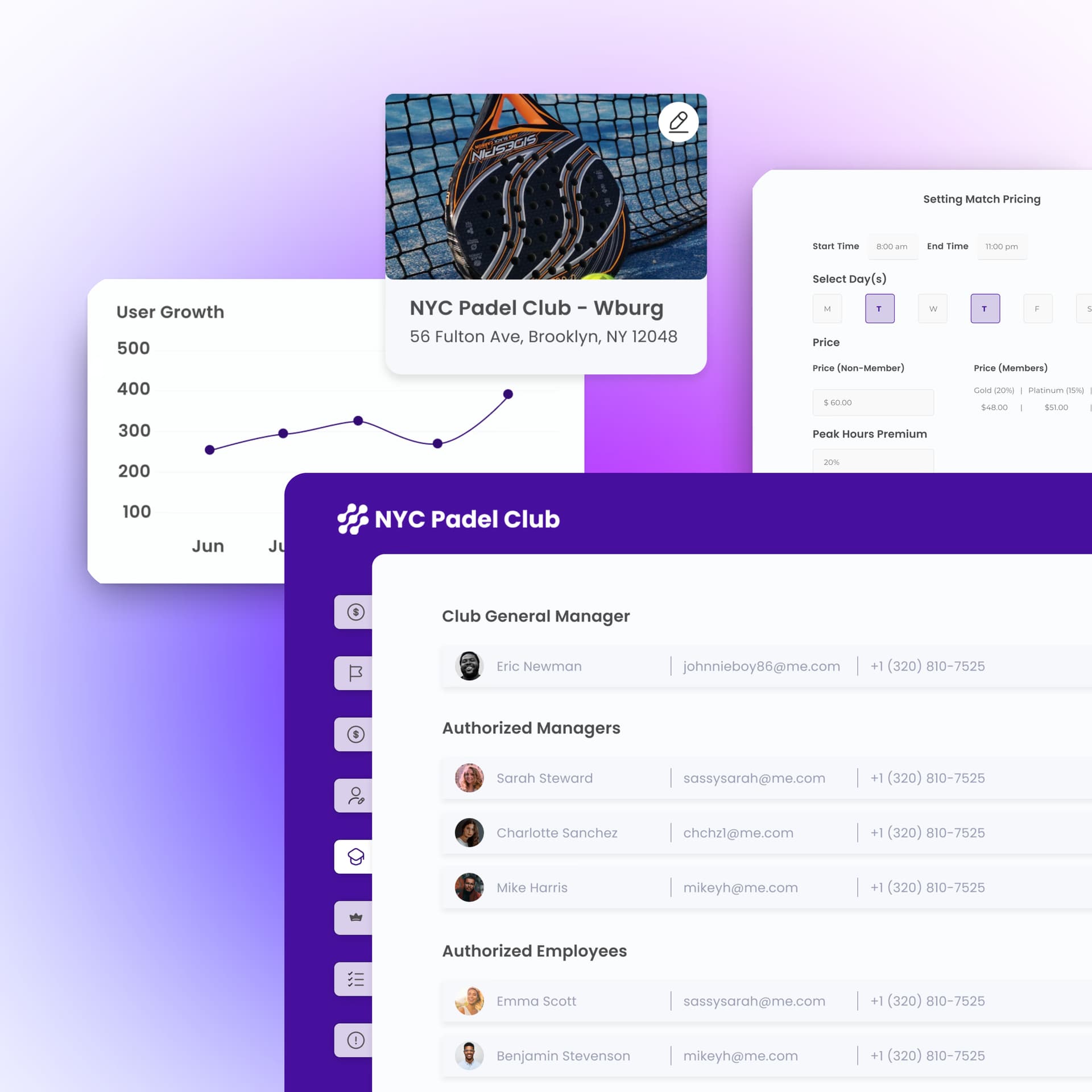
Specifically, clubs at the planning or early operating stage should prioritise three things in their operations layer before focusing heavily on marketing. First, a booking system that handles real-time court availability, automated confirmations, and cancellation management — the basics that prevent the friction that drives members to competing clubs. Second, a membership structure built around actual usage patterns rather than generic pricing tiers, which requires visibility into how different member segments behave. Third, communication tools that let you reach specific member groups — everyone who has not booked in three weeks, everyone eligible for an event, coaching academy students — without manual list management.
Getting the operational layer right early is what separates clubs that scale with the market from those that struggle inside it. A club that sells 200 memberships and then delivers a poor booking experience does not convert those members into long-term advocates — it converts them into churn data. Serve is built specifically for padel clubs navigating this growth. If you are in the planning stage, opening soon, or running an operation that has outgrown its current tools, book a demo to see how the platform handles bookings, memberships, payments, and member communication in one place.